

Why CLN4 Is a Promising Target for ASO Therapy
 CLN4 has a single, well-defined genetic cause, and that cause points directly to a treatment strategy.
How DNAJC5 Variants Cause CLN4
Batten disease is the common name for the neuronal ceroid lipofuscinoses (NCLs), a group of rare inherited neurodegenerative disorders. Each form is numbered by the gene involved. CLN4, also called adult-onset NCL or autosomal dominant Kufs disease, is caused by a change in one copy of the DNAJC5 gene. Symptoms usually begin in adulthood.
DNAJC5 makes a protein called CSPα, which helps keep proteins at the brain’s synapses properly folded and working. In CLN4, the altered gene produces a faulty form of CSPα. Researchers have shown that this faulty protein damages and eventually kills brain cells rather than simply failing to do its job. Work by Dr. Velinov and colleagues suggests the disease may be eased by selectively lowering the protein made from the altered copy of the gene.
That is exactly what an ASO can be designed to do.
For more on how CLN4 is inherited and confirmed through testing, see CLN4 genetics and diagnosis.
Why recurring variants matter for future patients
Reported CLN4 cases cluster at the same small region of DNAJC5, most often involving two recurring changes, known as p.Leu115Arg (L115R) and p.Leu116del. Both were first identified in 2011 and have since been confirmed in unrelated families.
Because many people with CLN4 share these variants, an ASO developed for one person could potentially benefit others with the same genetic change. Each new patient would still need careful medical evaluation and regulatory review. Even so, one therapy could become a foundation for the wider CLN4 community rather than a one-time effort.
What Is ASO Therapy?
An antisense oligonucleotide (ASO) is a short, synthetic strand of genetic material designed to bind to a specific RNA message inside cells and change how a gene is expressed.
Genes work by sending RNA “instructions” that cells use to build proteins. An ASO is built to match one precise stretch of those instructions. Depending on its design, it can flag a harmful message so the cell breaks it down, or it can redirect how the message is assembled so the cell makes a working protein.
How an ASO could work in CLN4
In CLN4, the goal is to reduce the harmful form of CSPα. The ASO under development is designed to decrease production of that protein, with the aim of slowing or preventing the damage it causes to brain cells. Because ASOs act in the brain and spinal cord, they are typically given by lumbar puncture into the fluid surrounding the spine.
ASOs already in use for other conditions
ASO therapy is not a new idea. Several ASOs have earned FDA approval, and others have been made for individual patients:
- Nusinersen (Spinraza) treats spinal muscular atrophy and is delivered to the spinal fluid, much as a CLN4 ASO would be.
- Tofersen (Qalsody) was approved by the FDA in 2023 for ALS caused by SOD1 variants. Like CLN4, SOD1-ALS involves a harmful protein, and tofersen works by lowering it. This is the closest approved model for the CLN4 approach.
- Milasen, developed by Dr. Yu’s team for a young girl with CLN7 Batten disease, was the first ASO custom-designed for a single patient. It moved from first contact to treatment in about one year. The team reported no serious adverse events and a reduction in seizures.
These results show what ASOs can do. They do not guarantee the same outcome in CLN4. Every new ASO must prove its safety and benefit on its own.
What Is N-of-1 (Individualized) Therapy?
An n-of-1 therapy is a treatment designed, tested, and given for one patient, or a very small number of patients, who share a specific genetic variant.
Traditional drug development depends on trials with hundreds or thousands of participants. For ultra-rare conditions like CLN4, there are simply not enough patients for that model, and commercial drug developers rarely invest. Individualized therapy offers another path. Scientists design a treatment around one person’s exact genetic change, test it rigorously in the laboratory, and, with regulatory permission, give it under close medical supervision.
A growing global field
In 2021, Dr. Yu co-launched the N=1 Collaborative, a global community of researchers, clinicians, drug developers, patient advocates, and regulators working to advance individualized medicines. The Collaborative’s mission is to make these therapies safe and quickly accessible to patients worldwide by sharing knowledge, resources, and data across institutions.
How regulators oversee individualized ASOs
The U.S. Food and Drug Administration has issued dedicated guidance for this kind of work. In December 2021, the FDA released draft recommendations for individualized ASO therapies for severely debilitating or life-threatening diseases. In February 2026, it added a draft Plausible Mechanism Framework describing how individualized therapies for conditions with a known genetic cause can generate the safety and effectiveness evidence needed for approval.
These guidances matter for CLN4. The FDA notes that when more than a few patients may be candidates for the same ASO, developers should discuss a broader development plan. Because CLN4 variants recur, a successful individualized ASO could become the starting point for a therapy that reaches more families.
Current CLN4 Research Efforts
In 2026, the Batten Disease Global Research Initiative awarded a research grant for a project titled An Antisense Therapy for DNAJC5 Knockdown in CLN4 Batten Disease, led by Dr. Timothy Yu and Dr. Milen Velinov.
The Research Team
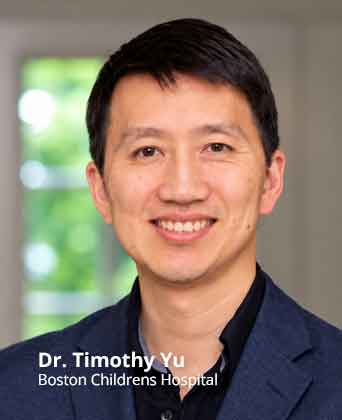
Timothy Yu, MD, PhD is a physician-scientist in the Division of Genetics and Genomics at Boston Children’s Hospital and Harvard Medical School. His team developed milasen, the first individualized ASO, and later atipeksen for a child with ataxia-telangiectasia. He co-founded the N=1 Collaborative and has worked with the FDA on regulatory pathways for individualized medicines.
Milen Velinov, MD, PhD is a Professor of Pediatrics and Genetics and Director of the Division of Genetics at Rutgers Robert Wood Johnson Medical School. His research helped identify the genetic basis of DNAJC5-associated CLN4, and he led a Batten disease registry for more than ten years.
They are supported by collaborators at institutions around the world who contribute expertise in genetics, neurology, drug development, and patient care.
Where the work stands today
The project is in the laboratory stage. The team is designing ASOs to reduce harmful CSPα and testing them in cells grown from people with CLN4 to see whether they lessen disease-related effects. Positive laboratory results are the first requirement before safety studies, regulatory review, and any treatment of a patient can begin.
This section will be updated as the research progresses. Last updated: October 2026.
The Path From Research to Treatment
Developing an individualized ASO follows a careful, step-by-step process. Each stage must succeed before the next can begin. This is the same general path Dr. Yu’s team followed with milasen.
- ASO design and synthesis (current stage). Scientists design candidate ASOs that match the RNA from the altered DNAJC5 gene and produce them for testing.
- Laboratory validation (current stage). Candidates are tested in cells from people with CLN4 to confirm they lower harmful CSPα and reduce signs of disease.
- Preclinical safety studies. The leading candidate undergoes toxicology and pharmacokinetic testing to understand safety, dosing, and how long it lasts in the body.
- Manufacturing. The final ASO is produced to GMP (Good Manufacturing Practice) standards, the quality level required for human use.
- Regulatory submission. The team submits an Investigational New Drug (IND) application and must receive FDA permission before treatment begins.
- Treatment under clinical monitoring. The therapy is given in a hospital setting, typically by lumbar puncture, with close medical oversight.
- Long-term follow-up. Doctors track safety and any changes in the disease over time. These findings also help future patients.
Timelines depend on laboratory results, safety findings, regulatory review, and funding. Milasen moved from first contact to treatment in about a year, but every program is different and no outcome can be promised.
Why Research Funding Matters
Individualized therapies depend on charitable support. Boston Children’s Hospital reports that developing the Yu lab’s individualized ASOs, such as milasen and atipeksen, cost an average of $1.6 million per program and required the support of charitable foundations. Hope 4 Batten Foundation was founded by Alison’s family to help close that gap, for Alison and for every family facing CLN4.
Why traditional funding falls short
Pharmaceutical companies generally invest in treatments that can reach large numbers of patients. Government and foundation grants, while vital, are usually modest and focused on early research. The 2026 CLN4 grant, for example, was $50,000. This leaves a funding gap between promising laboratory work and a therapy a patient can actually receive.
What your support helps fund
- ASO design and GMP-grade manufacturing
- Toxicology and pharmacokinetic studies
- Regulatory preparation and FDA submission
- Clinical care infrastructure, including hospital procedures and testing
- Ongoing safety and effectiveness monitoring
Beyond one patient
Every step completed for CLN4 builds knowledge that others can use. Because CLN4 variants recur, an ASO developed now could serve future patients who share the same genetic change. The data gathered also strengthens the shared framework for individualized therapies across many rare genetic diseases.
Frequently Asked Questions About CLN4 Research
Is there a treatment for CLN4 Batten disease?
Not yet. There is no approved treatment for CLN4. An experimental ASO therapy is in development, and care today focuses on managing symptoms.
What is an ASO, in simple terms?
An ASO is a short, synthetic strand of genetic material that attaches to a specific RNA message in cells. In CLN4, it is designed to reduce production of the harmful protein that damages brain cells.
Could this therapy help other people with CLN4?
Possibly. Reported CLN4 cases most often involve one of two recurring variants in the DNAJC5 gene. An ASO designed for one of these variants could potentially be used for others who share it, after medical evaluation and regulatory review.
How long does it take to develop an individualized ASO?
It varies. Dr. Yu’s team developed milasen in about one year, which was considered exceptionally fast. Timelines depend on laboratory results, safety testing, FDA review, and funding.
Is ASO therapy safe?
All ASOs carry risks, and each new one must be tested for safety before use. FDA-approved ASOs have established safety records, but an individualized ASO is experimental. It is given only with FDA permission and under close medical monitoring.
How are donations used?
Donations fund the costly steps that traditional grants rarely cover, including ASO manufacturing, safety studies, regulatory preparation, clinical care, and long-term monitoring.
Is my donation tax-deductible?
Yes. Hope 4 Batten Foundation is a 501(c)(3) nonprofit organization (EIN 43-2313368). Donations are tax-deductible to the extent allowed by law.