
Alison and Dennis’ Story
I have heard the words “Batten disease” twice in my life. The first time, in 1990, they were about my husband, Dennis. The second time, in 2024, they were about our daughter, Alison. This is their story, and the reason our family believes this time can be different.
Barbara LaBarge
Co-Founder, Hope 4 Batten Foundation
Where Our Journey Began
In 1986, Dennis had two seizures in a single day. He was 34 years old and had never had a health problem. Doctors diagnosed late-onset epilepsy. Over the next four years, though, I watched him have more seizures and mild cognitive problems that no one could explain.
In 1990 we finally got an answer. A pathology slide identified Adult Batten disease, also known as Kufs disease. Today we know Dennis’s form as CLN4, a rare genetic disorder that progressively affects movement, thinking and quality of life. Back then, it was a disease I had never heard of.
Sixteen Years Without a Path to a Cure
For sixteen years, Alison and I watched Dennis decline, with no treatment and no hope of a cure. Over time he lost the ability to walk, to talk and to swallow. Unlike someone with Alzheimer’s, he always knew his family, his friends and the people who cared for him.
There were no support groups for families like ours. People with cognitive decline usually aren’t in their 40s with young children at home. I felt very alone, and none of Alison’s friends could understand what her life was like.
Dennis passed away at the age of 54.
Alison: Her Father’s Daughter
When her father died, Alison was in college, working toward her master’s degree in education. She had grown into a beautiful young woman, and she was so much like her dad: kind, smart and athletic.
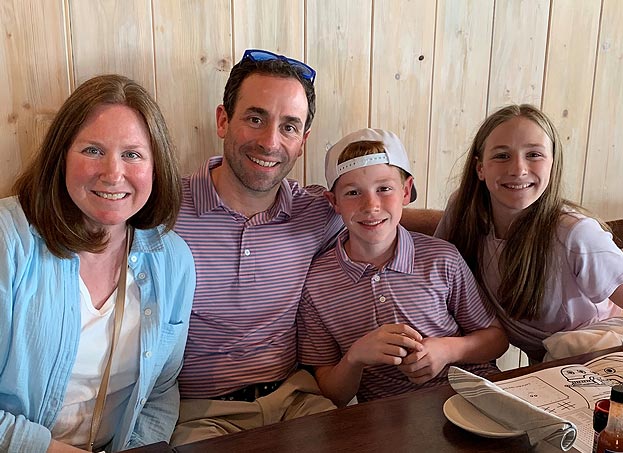
After college she met Nick, and they married in 2010. Together they built a family with two wonderful children, Kaleigh and William.
2019: The Night Everything Changed Again
In 2019, Alison was getting ready to go out to dinner with Nick when she had three seizures. She was 36, close to the age her father was when his first seizures came.
In a flash, our lives changed forever again. This time it wasn’t just Alison and me. It was Nick, Kaleigh and William too. Another family was now facing CLN4.
In the fall of 2024, genetic testing confirmed that Alison carries the same genetic mutation as her father.
Living with CLN4 Today
At first, Alison’s seizures were rare. Over the past few years they have become frequent and very hard to control. Her memory and thinking are declining, her balance is unsteady, and she worries about what the future holds.
Alison is fighting every day to stay present in her children’s lives. Helping with schoolwork and managing daily life have become hard for her, and she feels so much is being taken away. More and more of the family’s life rests on Nick, who is now a full-time parent, provider and caregiver, often without the partner he built that life with.
I have already mourned my husband. Now I am watching my only child fight the same disease.
“Our journey with CLN4 has been like riding a lazy river for a long way. All of a sudden, the current gets stronger and stronger until you’re facing rapids and a precipice.”
A Life Raft Her Father Never Had
For the first time, our family has been given real hope.
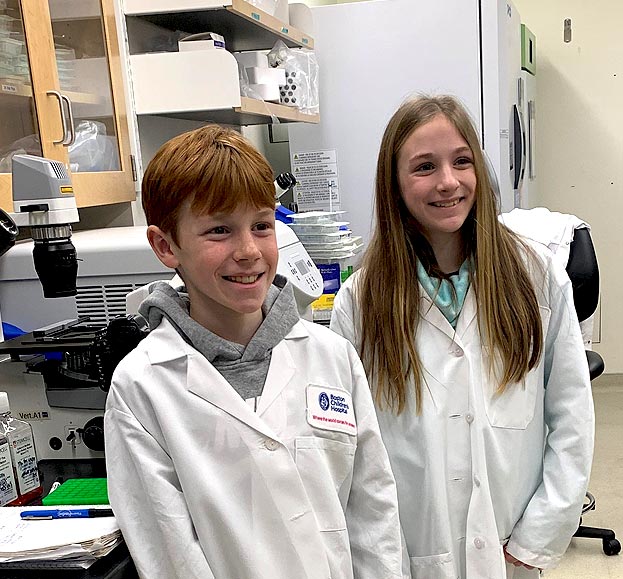
Dr. Tim Yu and his lab at Boston Children’s Hospital are working to understand CLN4 Batten disease. They are organizing a clinical trial at Mass General Brigham that could introduce a therapy designed to stop it. Alison has agreed to take part, both for herself and in the hope of helping others.
The trial is built around an antisense oligonucleotide (ASO), an experimental therapy designed to target the specific genetic change that causes Alison’s disease. Because it is made for one person’s exact mutation, it is called an “n-of-1” therapy. An ASO developed for Alison could also help others who carry the same variant. It could also help build a path for future personalized therapies for other rare genetic diseases.
Creating a therapy like this is a long, carefully monitored process. Most of its costs aren’t covered by traditional funding sources. Learn more about [individualized ASO therapy for CLN4](link to Research).
“This genetic disease cannot include a third generation. No one should ever have to endure generations of loss.”
Why a Four-Leaf Clover
Alison was born on March 17th, St. Patrick’s Day. A four-leaf clover is a rare mutation of the ordinary three-leaf clover. Alison’s path is extraordinarily rare too, but like the clover, she and everyone like her will be defined by their strength and uniqueness.
Each leaf stands for something that carries our family forward:
- Hope: believing that advances in research and treatment will become reality.
- Faith: the strength to keep going through uncertainty.
- Love: the compassion that surrounds every family affected by Batten disease.
- Luck: honoring the rarity of the four-leaf clover, and the extraordinary rarity of CLN4.
From Our Family to a Foundation
In 2026, Nick and I founded Hope 4 Batten Foundation so that the hope we have been given doesn’t stall for lack of funding. Funds we raise support the CLN4 clinical trial effort at Mass General Brigham and research groups studying the DNAJC5 gene behind CLN4.